
Technology investment is often seen as Smart Technology Investment for Business | IFARA a sign of business progress.
Enhanced software, platforms, and automation empower your operations. New AI capabilities complete the picture with Smart Technology Investment for Business | IFARA.
But more technology does not necessarily create a better business with Smart Technology Investment for Business | IFARA.
For an emerging company, the problem may be investing too early in systems it doesn’t yet need.
For a large enterprise, the problem is substantial. Years of technology investment can create overlapping applications and disconnected data. This accumulation worsens risks and reduces agility across lines of business. Leaders struggle to align priorities amid fragmented tech assets. Effective governance becomes harder without a clear roadmap.
Underused platforms and increasing complexity strain operations. Smart Technology Investment for Business | IFARA offers guidance for optimizing these choices. A clear strategy focuses on integration, data quality, and scalable platforms. It helps teams move from silos to shared insights across the organization. This framework supports the transformation across people, processes, and technology.
At IFARA, we believe Smart Technology Investment for Business | IFARA should not begin the question. We aim to frame the discussion clearly.
“What technology should we buy?”
It should begin with:
“What does the business actually need?”
Every Business Is a Business
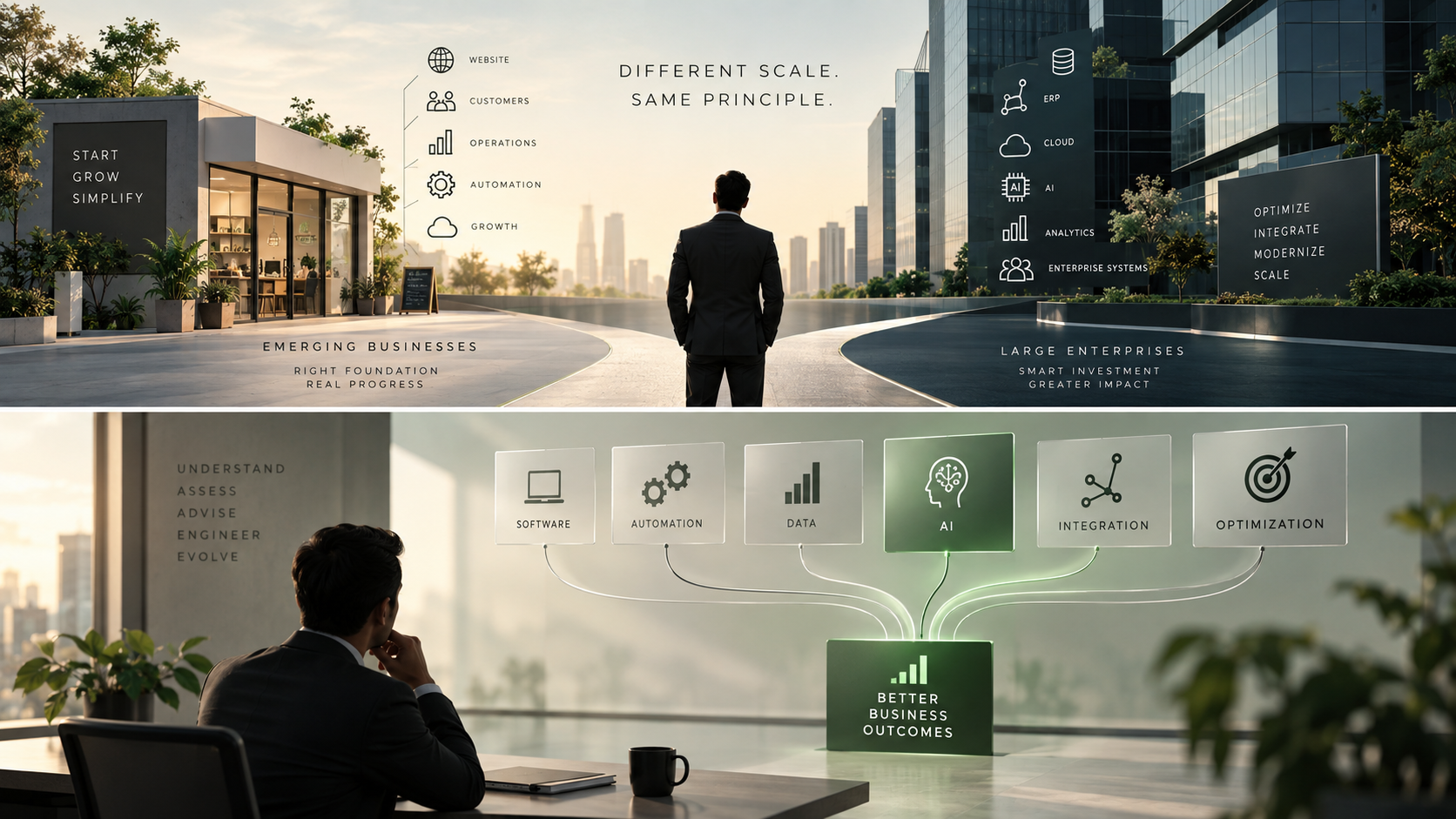
We don’t believe technology strategy should be defined simply by whether an organization is called a small business, mid-sized company or large enterprise.
The scale changes.
The complexity changes.
The investment changes.
But the fundamental principle remains the same:
Technology should create measurable business value.
An emerging business may need a strong digital foundation, better customer management or a simple operational system.
A large enterprise may need to connect fragmented systems, modernize applications, improve data visibility, automate complex workflows or introduce AI into decision-making.
Different scale. Different challenge.
Same principle: invest where technology creates value.
Why We Support Smaller Businesses Differently
Smaller businesses often face a difficult situation.
They need technology guidance, but a significant consulting engagement may itself consume the budget they need to actually build something.
That creates a contradiction.
A business needs guidance before investing — but cannot justify spending heavily just to determine what it should invest in.
This is why IFARA can approach selected smaller businesses through an initial digital assessment or audit without making consulting fees the first barrier to the conversation.
We can first understand the business, identify meaningful technology opportunities and help determine what deserves investment.
The purpose isn’t to push more technology.
It’s to help businesses avoid making the wrong technology decisions.
For Enterprises, the Problem Can Be the Opposite
Large organizations usually don’t suffer from a lack of technology.
They may already have ERP platforms, CRM systems, cloud infrastructure, analytics applications, internal software, automation tools, data platforms and now multiple AI initiatives.
Yet another problem begins to appear:
Technology accumulation.
One department purchases a platform.
Another builds an internal application.
Another introduces an automation tool.
Another launches an AI initiative.
Individually, each decision may appear reasonable.
Collectively, the organization can end up with duplicated capabilities, disconnected information, unnecessary licensing costs and increasingly complicated architecture.
The question is no longer:
“What else should we implement?”
It becomes:
“What should we actually keep, connect, improve, replace or stop?”
AI Makes This Question Even More Important
The current AI wave makes disciplined technology investment even more critical.
Businesses are being encouraged to implement AI agents, copilots, intelligent automation, predictive analytics and generative AI across almost every function.
Some of these investments can create enormous value.
Others may solve problems that didn’t require AI in the first place.
Sometimes workflow automation is enough.
Sometimes an existing platform already contains the required capability.
Sometimes better data integration creates more value than introducing another application.
And sometimes AI genuinely can transform how the organization operates and makes decisions.
The important part is knowing the difference.
Smart Technology Investment Is Not About Spending Less
This distinction matters.
IFARA’s approach is not simply about reducing technology budgets.
Sometimes the right recommendation may actually require significant investment.
The objective is to ensure that investment is intentional, justified and connected to a business outcome.
A ₹10 lakh solution that solves the wrong problem is expensive.
A ₹1 crore platform that fundamentally improves a critical enterprise operation may be an excellent investment.
Cost alone doesn’t determine value.
Business impact does.
Assess Before You Invest
Before introducing another technology into the organization, we believe decision-makers should understand:
The Business Need
What problem or opportunity are we addressing?
The Existing Environment
What technology and capabilities already exist?
The Gap
What is preventing the desired business outcome today?
The Right Intervention
Do we need process improvement, integration, automation, software engineering, data intelligence or AI?
The Expected Value
What measurable improvement should this investment create?
This changes technology from a purchasing decision into a business decision.
Where IFARA Fits
IFARA works at the intersection of business decisions and technology engineering.
For emerging businesses, that can mean helping establish the right digital and technology foundation without unnecessary complexity.
For established and large enterprises, it can mean assessing technology environments, identifying gaps, connecting systems, engineering solutions, introducing automation or AI where appropriate, and challenging investments that do not create sufficient business value.
We don’t begin with a product that needs to be sold.
We begin with the business that needs to be understood.
Because sometimes the right answer is to build.
Sometimes it is to integrate.
Sometimes it is to automate.
Sometimes it is AI.
And sometimes the smartest technology decision is not to invest at all.
Technology Should Help the Business Grow — Not Become the Burden
The most technologically advanced organization isn’t necessarily the one using the most technology.
It is the organization that understands where technology matters.
That principle applies whether you’re building your first digital operation or managing technology across a large enterprise.
At IFARA, our role is to help businesses make those decisions with greater clarity — and engineer the right solutions when technology is genuinely required.
Because better technology begins with better decisions.
Every Decision Deserves Intelligence.